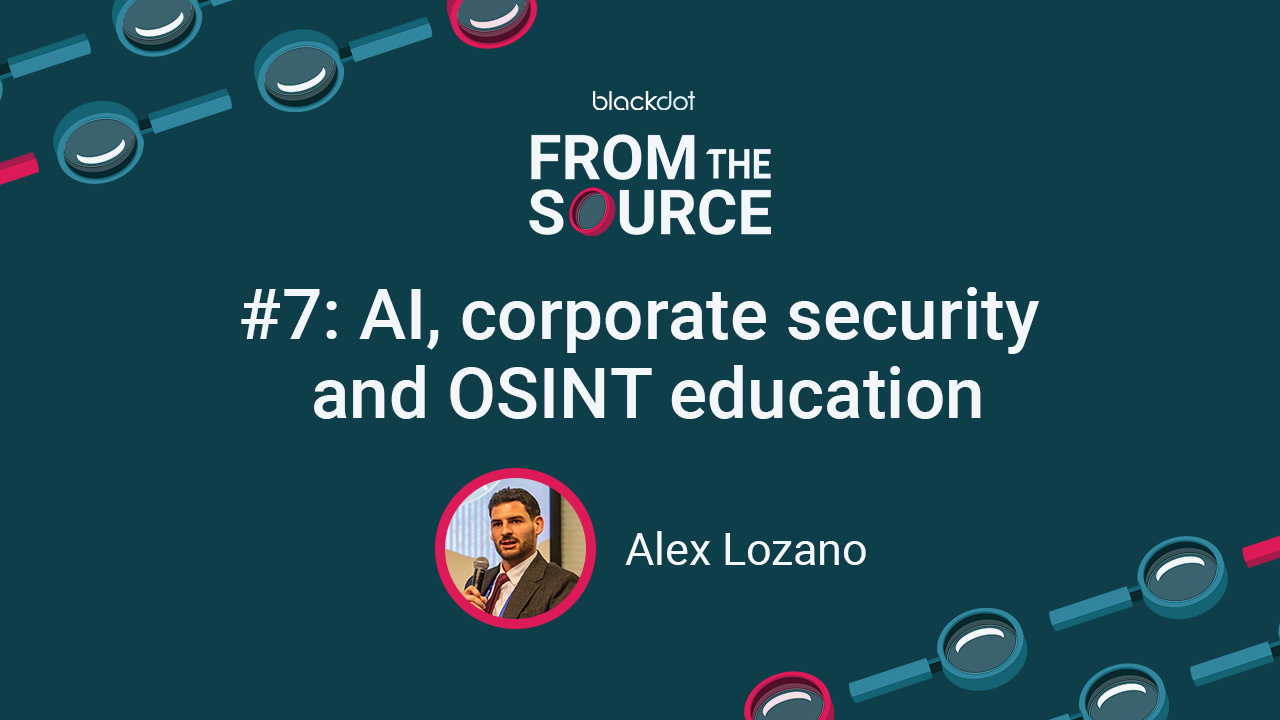
Alex Lozano, OSINT educator at UAB in Barcelona and founder of Cibergy, joined the latest episode of From the Source, the Blackdot podcast. In this episode, he discusses artificial intelligence (AI), corporate security, social media and much more. You can read his insights below or listen to ‘AI, corporate security and OSINT education with Alex Lozano’ here.
Founding Cibergy and being an educator
Alex worked as a private investigator and OSINT analyst for eight years before deciding to complete a master’s degree in cyber intelligence. Three years ago, he founded the investigation firm Cibergy to help clients gather and analyse information, focusing mainly on corporate security. Last year, the organisation evolved to create OSINT Excellence, an online training academy. Outside of Cibergy, Alex is an OSINT professor at the Universidad Autónoma de Barcelona.
Integrating OSINT into corporate security
Alex explains that OSINT for corporate security includes background checks to help businesses understand who they are hiring and vendors they work with, as well as reputation management, corporate investigations, monitoring, and more.
‘What we're trying to do with the integration of OSINT into corporate security is to update the field,’ he begins. ‘For example, a lot of things that happen nowadays happen in the online space. We have to be ready to protect both the companies and the employees through, for example, digital risk assessments, and to be able to monitor and detect all those threats and risks that happen in the digital world.’
He believes that businesses should have an OSINT team dedicated to protecting the company’s interests. For big companies in critical sectors, like pharmaceuticals, oil, water and energy, he feels there should be a 24/7 capability, which requires larger budgets, more advanced tools, or in some cases, outsourcing to companies like Cibergy.
‘We must be able to monitor, we must be able to detect, we must be able to investigate,’ he states. ‘And in the same way you have the best tools for constructing a building, you need the best tools for collecting your investigations and protecting your assets, your company and your employees.’
AI and OSINT
When it comes to AI in corporate security, Alex explains that it’s still very new, but there are some key benefits:
Gathering information is an important part of OSINT. Alex says that social media monitoring for corporate security, for example, could benefit from AI in the near future.
‘We can find thousands of accounts, mentions, keywords, topics that may or may not be important for our company,’ he says. ‘Even though this hasn't been developed fully, I can see in the next few years a lot of advances in which artificial intelligence is going to help us organise this information, pick up what information is the most relevant… then we can just focus on the negative stuff so that we can optimise our resources, our time and our effort.’
2: Speed and resources
Alex explains that AI enables fewer analysts to gather and organise more information much faster. He adds that, when combined with advanced platforms like Blackdot’s Videris, this is even more efficient, requiring even fewer analysts.
‘We're combining technology with humans with intelligence analysts in a way that we're improving the whole system exponentially,’ he says.
Modern AI features like facial recognition can help identify social media profiles, which Alex says would have previously been done manually. Geolocation has numerous potential applications, such as helping to prevent human trafficking.
The dangers of AI
While it’s a powerful tool, Alex acknowledges that we could be over-relying on AI, which can be harmful. He believes it should help humans and not replace them.
‘It seems like the answer AI is giving us is the ideal answer and it's not. At least, right now, I think that we are smarter than AI in many things,’ he says. ‘I mentioned before the way it analyses and organises things is getting better and better, but it's not perfect.’
As a professor, he notices his students using AI. While the access to information is valuable, he often sees assignments that feature the same arguments and formats, which have clearly been completed by or heavily influenced by ChatGPT.
Teaching OSINT
In OSINT, tools and technology moves fast. For Alex, it’s important to teach students the concepts and methodologies before the tools.
‘We don't know if you're going to work by yourself or you're going to end up working in a big international company with thousands of dollars of capital to invest in the best tools,’ he says. ‘This doesn't really matter if you know what are the steps you want to take. And then you can learn and adapt to the tools.’
He explains that for many people, OSINT is initially self-taught. People won’t realise that what they are doing is investigating. Some will go on to study related degrees, others will complete courses with the SANS Institute or OSINT Academy, and others will continue to self teach. Whatever their approach, Alex ultimately believes that formal education can always help OSINT investigators improve.
Listen to AI, corporate security and OSINT education with Alex Lozano in full and stay tuned for even more OSINT insight on Blackdot’s next podcast episode.